
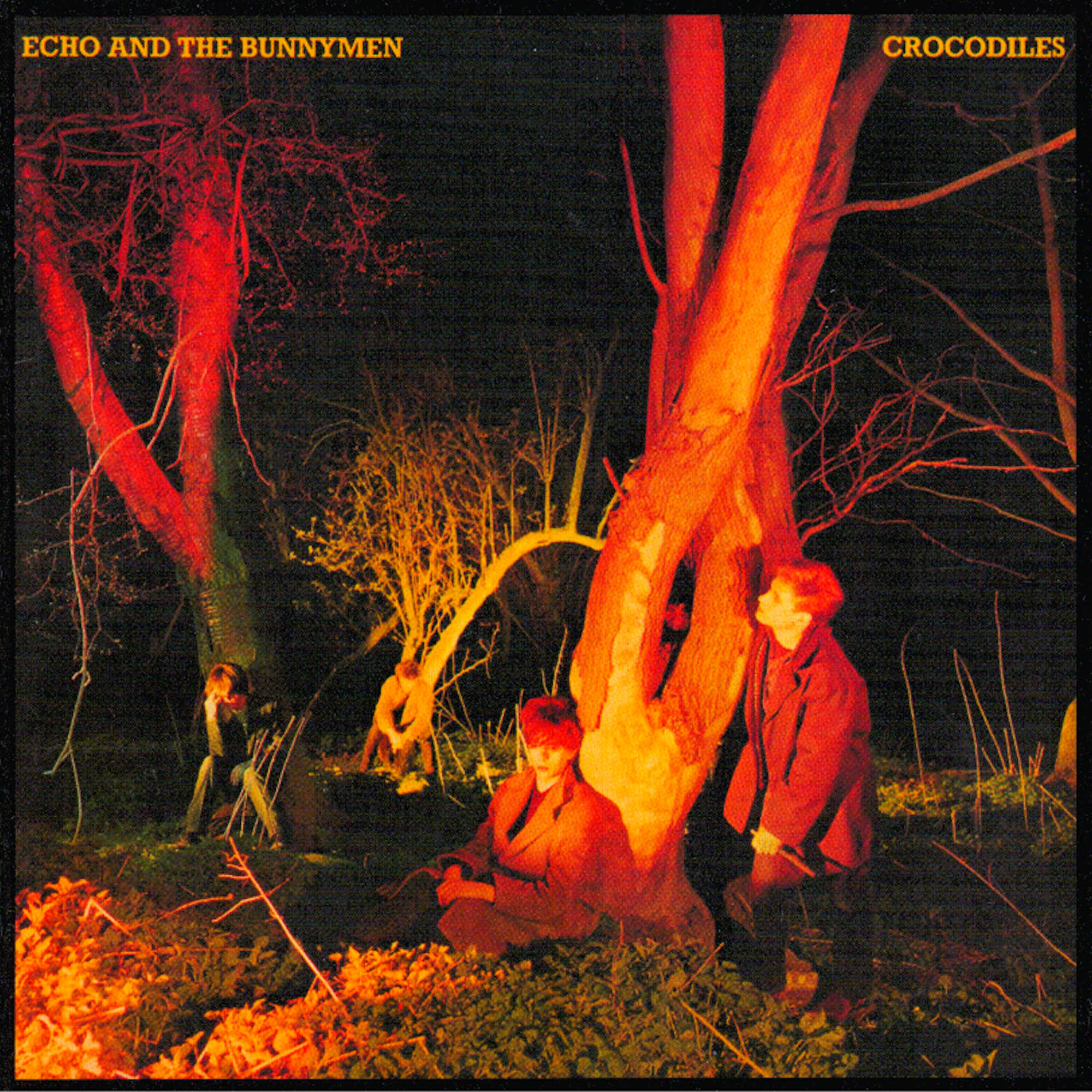
tracks on LP: Going Up / Stars Are Stars / Pride / Monkeys / Crocodiles / Rescue / Villiers Terrace / Pictures On My Wall / All That Jazz / Happy Death Men
Korova Records KODE 1
Producer: The Chameleons and Ian Broudie
Recorded at Rockfield Studios
Ian McCulloch: vocals, guitar
Will Sergeant: guitar
Les Pattinson: bass
Pete De Freitas: drums
with David Balfe on keyboards
Released: July 1980
Purchased: 26/02/83
‘Crocodiles’ is everything it should be – it’s especially effective because it deals with the very dilemmas Echo and the Bunnymen may have to face.
“Pride” and “Stars Are Stars” are clear enough guidelines, the former a personal, embittered throwback to Ian (vocals) McCulloch’s youth, a statement of intent in the face of parental pressure – the man who would be popstar! – the latter a song of similar insecurities (“I caught a falling star / it cut my hands to pieces”).
“Going Up” fits the pattern too, in many ways an archetype for the kind of sound the Bunnymen are beginning to develop rich, fervent, rooted in the sixties Doors, Velvet Underground etc, pointing forward from there Pete De Freitas‘ drumming, Les Pattinson‘s bass and Will Sergeant‘s guitar shuddering around a lavish production mix, dipping furiously in and out of dark shadows – a perfect foil for Ian McCulloch‘s elusive, mournful voice.
“Monkeys”, “Villiers Terrace”, “All That Jazz”, stand them in a line, look at them growing, contrasting, clashing against one another, adopting new shapes, meaning different things at different times.
“Happy Death Men” closes the album on a sharp, doom-laden rejoinder: it leaves ‘Crocodiles’ bulging and bubbling over a catalyst of dark effervescence, vague without vogue.
Of course, it’s only rock and roll – but if rock and roll’s one of few things we have left to play with, we have to make it work in new ways, from romance to arrogance, from insight to despairing confusion, all the things rock and roll’s never seen.
Groups like Echo and the Bunnymen will be having a hard time over the coming months. Without contraptions like pigeon-holes, few groups are able to make a lasting impression on staid public / media consciousness; great rock and roll – which this is, sadly doesn’t seem to be enough.
‘Crocodiles’ is a hefty first shot, almost this year’s first masterpiece. ***** (Record Mirror, 12/07/80)

ECHO AND THE BUNNYMEN Crocodiles (Korova) THE TRANSFORMATION of Echo And The Bunnymen from the appealing but erratic beatniks of a year ago to the dynamic modern rock group of today has been little short of remarkable.
It has been a painless change of style but one in which the effects could hardly be more marked. The haunting semi-acoustic strains of their original Zoo 45 ‘The Pictures On My Wall’ are a far cry indeed from the hard, vigorous funk of the recent ‘Rescue’ single.
If ‘Rescue’ hinted broadly at the shift that had taken place, then ‘Crocodiles’, the debut album, confirms it in the most gratifying manner. There truly is a different kind of tension at work now.
So what is it all down to? Well, on the most basic level, the recruitment of drummer Pete De Freitas in place of the drum machine ‘Echo’ which formerly provided the rhythmic backdrop has toughened up the sound considerably, giving things a solid and imaginative root.
But there is more to it than that. Singer Ian McCulloch‘s gruff voice has matured magnificently, so that every song is now infested with a rare soul and intensity. In common with all great rock and roll from Springsteen to The Sex Pistols, Echo And The Bunnymen now sound hungry, and a lot of that hunger can be traced back to the sense of desperation and urgency in McCulloch’s vocals.
Echo And The Bunnymen | Crocodiles | Korova | 1980
If McCulloch and De Freitas give the Bunnymen the essence of their new-found strength, then the embroidery and embellishments are left to guitarist Will Sergeant and bassist Les Pattinson. Sergeant is the star of the show musically, his gothic, jangling guitar motifs often stretching miles into the distance behind Pattinson’s elastic bass.
Together they have a great sense of rock dynamics, though a lot of the credit for that could also go to the production team of — no, not Martin Hannett! —Chameleons Bill Drummond and Dave Balfe and Original Mirrors guitarist Ian Broudie.
The three men at the controls create a sound full of body and depth without the aid of convoluted studio trickery, the odd splash of resonant echo aside: there is very little on ‘Crocodiles’ that couldn’t — or indeed, hasn’t — been reproduced live.
The Bunnymen betray a host of influences throughout the album. There are shades of both Jim Morrison and Iggy Pop in McCulloch’s voice, shreds of Wilko Johnson in the vicious crosscut riffing of Sergeant on the title track (or is that you, Andy Gill?) and definite aspects of Talking Heads in ‘Rescue’, while the chilling organ melody on the re-vamped ‘Pictures On My Wall’ certainly owes something to Pere Ubu’s ’30 Seconds Over Tokyo’.
But this crocodile is no imitation skin, and the whole is far greater than the sum of the various inputs. McCulloch’s lyrical landscape is scattered with themes of sorrow, horror and despair, themes that are reinforced by stormy animal/sexual imagery. There are resemblances to Joy Division in places, although McCullough’s words are never as intensely personal.
‘Crocodiles’ and ‘Rescue’ deal with fear and eventual breakdown, desperation which takes the victim even closer to the edge on ‘Going Up’, where ambient mood music drifts into a semi-acoustic rocker with a haunting “Let’s get the hell Outa here” refrain.
But the message filtering through the darkness is primarily one of hope on ‘Pictures On My Wall’ and ‘All That Jazz’, which employs to devastating effect the same relentless rhythmic thrash that drove PiL’s ‘Annalisa’ and Magazine’s ‘The Light Pours Out Of Me’.
Debauchery
‘Villiers Terrace’, meantime, is an awestruck and amusing account of people rolling round on carpets, mixed-up medicines and drugged debauchery, lifted by very Bowie-ish staccato electric piano.
Not every track is as successful. ‘Pride’ is a disposable recollection of parental hopes and fears, ‘Stars Are Stars’ an obscure dirge salvaged only by a few crisp minor chords, and ‘Happy Death Men’, a rambling closer which goes nowhere, reminding one of the Bunnymen’s still erratic live form.
One last thing. Forget all that jazz about the creeping return of hippiedom, despite the cryptic “flowers and their hair” message scratched over the run-off grooves.
‘Crocodiles’ is destined to be one of the contemporary rock albums of the year. And, yes, you can dance to it. How long before their picture’s on your wall? (NME, 12/07/80)

ECHO AND THE BUNNYMEN: “Crocodiles” (KOROVA KODE 1)
WHO’S kidding who? Echo and the Bunnymen have left the Mersey “Zoo” label to release a debut album which features a track called “Monkeys.” is on WEA’s sibling “Korova” (whose logo happens to be a cow) and a production credit goes to David Balfe and Bill Drummond who together go under the moniker “The Chameleons”.
Despite this incredible menagerie. however. the lads from Liverpool have delivered the musical goods to keep the bunny saga running inexorably forward.
Originally. a drum-machine three piece, they saved “real” drummer, Pete De Freitas. from academic incarceration. In order to toughen up the peculiarly compulsive, semi-acoustic sound that was characterised by the first single, “Pictures On The Wall”, The Bunnymen, which it was claimed . . . represented the dour Liverpudlian wit to a tee . . . have thrown off their naive charm for the expedience of progress.
If you took the “Stork” test with them, you would undoubtedly say that they’re an American band; the rhythms have a Velvet Underground feel, and Ian McCulloch‘s vocals have a Jim Morrison ring. However, these are merely references — the Bunnymen aren’t copyists.

Among the ten tracks are three already released songs: as well as “Pictures On The Wall,” with its memorable, Chinese like keyboards courtesy of David Balfe, there’s “Pride” and “Rescue”. Each is revamped rather than rehashed, proving the band’s insistence on forward movement. The change is most noticeable on “Pictures” which, without the fluid drumming of Pete De Freitas has a plaintively thin, haunting sound.
“Pride”, like “Crocodiles”, is a driving rocker in which the bass line breaks away from its marriage with drums. On the latter. an up-tempo number, the rhythm is literally driven by Les Patterson’s bass, while De Freitas weaves a percussive tapestry behind the guitars and vocals.
“Rescue” has a Talking Heads structure but, like several other songs, you get the feeling that lyrically, the Bunnymen are spreading the jam a little thin.
“Monkeys,” “All That Jazz”, and “Stars Are Stars” feature Will Sergeant’s characteristically simple guitar riffs, played with a psychedelic intensity. “All That Jazz” has the most interesting production ideas on the album, all jostling with each other.
“Going Up” is the first song, a jolty rocker with an “Alien” intro and probably the weakest, “Villiers Terrace” sounds like the acid mecca with ” . . . people rolling around on the carpet, biting wool and pulling strings . . “, a piano adding a briefly exciting respite from the simple rhythm.
The Bunnymen have dug admirable first burrow. Merseybeat with spiked waters is worth getting addicted to. (Melody Maker, 19/07/80)

Leave a Reply