
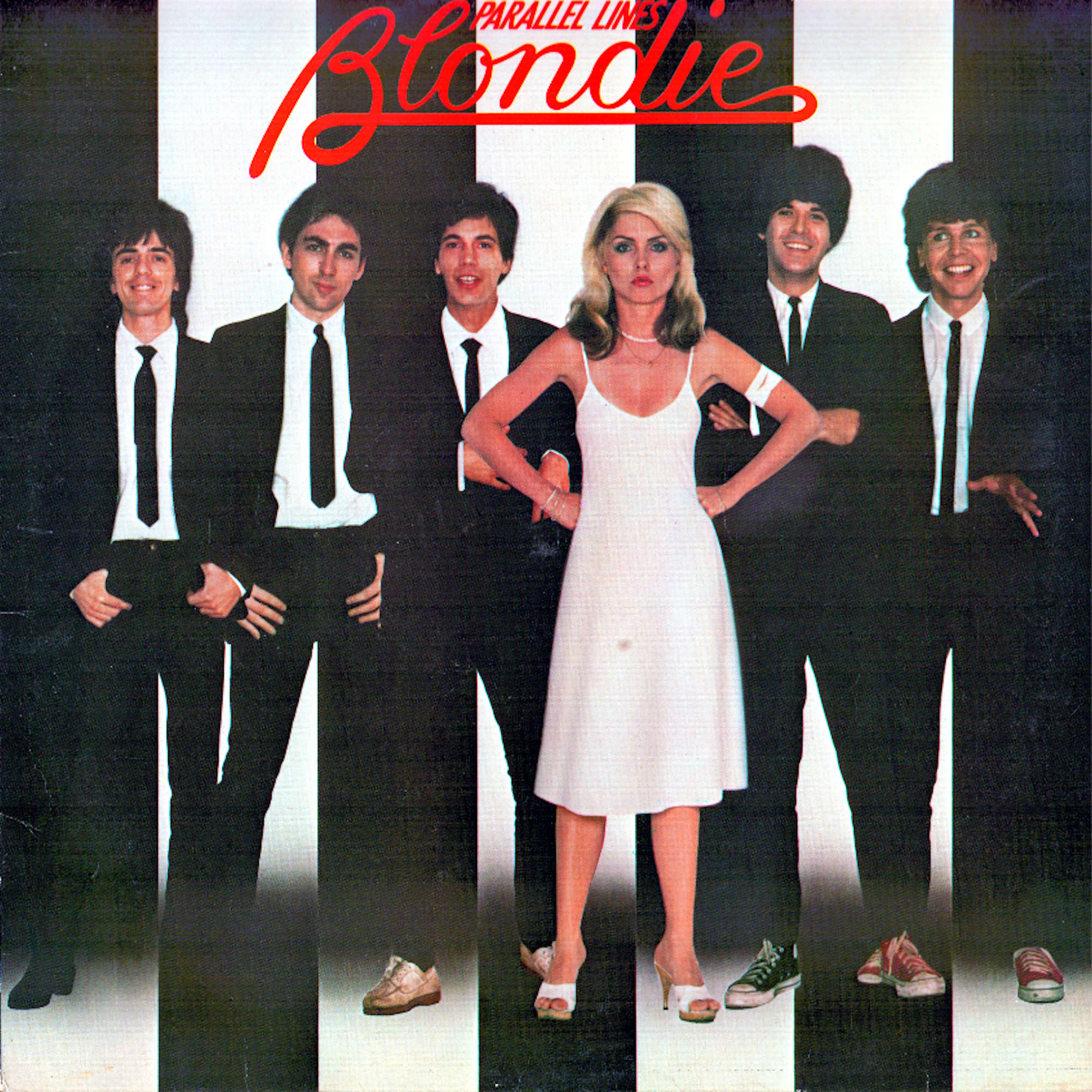
tracks on LP: Hanging On The Telephone / One Way or Another / Picture This / Fade Away (And Radiate) / Pretty Baby / I Know But I Don’t Know / 11:59 / Will Anything Happen? / Sunday Girl / Heart Of Glass / I’m Gonna Love You Too / Just Go Away
Record Label: Chrysalis CDL 1192
Producer: Mike Chapman
Recorded at the Record Plant, New York City
Released: 04/09/78
Purchased: 1979
Blondie | Parallel Lines | Chrysalis | 1978 | IN THE beginning Blondie were a New York pop group with a fabulous, sexy sixties sound, a girl with potential – amongst her other attributes – and an album full of cute ‘n’ catchy songs with a sting in their tail.
Today, Blondie are a fully qualified rock group with all that entails – onstage ego problems, guitar solos and heavier production jobs. Debbie Harry as anyone who follow s Mailman will know, is an Official Sex Symbol. But Blondie’s songs still have the same superstick formula – maybe not quite as instant as before but give them three or four listens and I guarantee they’ll be glued to your brain.
This combination of bubblegum songs chewing their way across a heavy backing sound gives the band room to create new depths; textures of sound which are a far cry from the one dimensional mood of their first album. Listen for example, to the breathless ‘Pretty Baby‘ “petite ingenue, teenage starlet I fell in love with you” or the elusive, distant charms of ‘Fade Away And Radiate.’
Blondie | Parallel Lines | Chrysalis | 1978
They can still churn out the more obvious tunes though . . . . as shown by their version of ‘I’m Gonna Love You Too’ (first recorded by Buddy Holly) or ‘Just Go Away’ a solo Harry composition which might not be the strongest number musically but lyrically is easily the sharpest. “Ya got a big mouth and I’m happy to see/Your foot is firmly entrenched where a molar should be/If you talk much louder you could get an award/From the federal communications board.”
The tracks aren’t all as as those – ‘Heart Of Glass’ for example is just too winsome and guitarist Frank Infante’s contribution, ‘I Know But I Don’t Know’ is fairly nondescript But on balance, the goodies easily outweigh the duffers.
So there you have it . . . the third third album of the new wave – only the Ramones and the Stranglers got there first and it’s another success story. For Blondie it’s the inevitable progression, a further move away from their tack ‘n’ trash beginnings towards the world of showbiz and professionalism. And if in the process, their innocence has been lost, well, maybe that’s a small price to pay + + + (Record Mirror, 09/09/78)

Woops, Blondie Show Roots
Everything seemed hunky dory when the first Blondie album hit home with it mating a ’60s girlie group innocence and a more worldly, sardonic even ’70s pitch. After all, these two disparate forces were harnessed with a fine grasp of what amounts to good, commercial pop / rock. There were sterling melodic structures, a plethora of graceful but tenacious hooks that simply wouldn’t let go and the proverbial ace up the sleeve in large helpings of irresistibly sexy wit.
After this sturdy start, the critical flak began, primarily with Julie Burchill’s negative appraisal of the second Blondie album. Ms Burchill lambasted “Plastic Letters” blaming various members of the band’s instrumental egocentricity for the problem on display. Mind you, other interested parties thought differently, hoisting as they did the record high into the charts throughout Europe and floating the successful single revamp of Randy & the Rainbow’ “Denis” to similar heights.
In retrospect, “Letters” was a commercial affair, fit to burst with winning songs and a cohesive fire that bound the band’s assorted abilities firmly together, whilst Debbie Harry‘s delectable, facile but nonetheless more than adequate vocals provided the cream on the cake.
Blondie | Parallel Lines | Chrysalis | 1978
Ms Harry had never sung as well as she’s looked – though to pinpoint her vocal deficiencies is somewhat unfair when one might remark that Chris Stein‘s guitar playing is itself at best merely adequate – but on “Letters” the Blondie whole became much greater than the sum of its parts. Indeed, that second album still stands as the band’s best effort so far – and then some.
“Parallel Lines”, you see, appears hamstrung by the insurmountable problems of being rushed, of lacking any tangible raison d’etre and of sounding inconsequential. Not so much bad as unnecessary.
No single song here leaps out at the listener in the way of the cocky “X-Offender” and “Kung-Fu Girls” or the sumptuous “In The Flesh”, all from the first album. Neither is there anything as stirring and uplifting as “Presence, Dear” or “Fan Mail”, irrepressible as “Love On The Pier”, as experimental and audaciously sinister as “Cautious Lip” . . .
The first single from “Parallel Lines” should have been the writing on the wall. Though apparently not the band’s first choice, it’s still easy to see why “Picture This” was chosen as the most commercial extract from the collection – simply because it seizes the attention immediately, although repeated listenings show the track to be nothing of note (indeed, it could have cropped up on either of the first two records without so much as raising an eyebrow).
Which is more than can be said for much of the rest of the album. Tracks like “Pretty Baby”, “11:59”, “Will Anything Happen” and “Sunday Girl” are little more than further versions of exactly the same formula the provided the first two albums’ archetypes – only this time the effervescence curdles into mere listlessness. Even the excellently titled “Heart Of Glass” is pure throwaway pop pap that stretches Debbie Harry’s oopy-doo sexuality a tad too far for comfort. In other words, it’s silly.
As with “Letters”, band democracy reigns supreme, everyone except drummer Clem Burke – who plays superbly throughout, by the way – contributes songs.
Blondie | Parallel Lines | Chrysalis | 1978
Frank Infante provides “I Know But I Don’t Know”, which begins by sounding like The Tubes in full techno-flash fights before rocking out in top-heavy form, a morsel of pogo-worthy fodder better left to The Ramones.
New bassist Nigel Harrison offers Ms Harry a chance to sing in a pleasingly feisty manner as she asserts herself over another inconsequential set of chord changes. That said, “One Way Or Another” is one of the few songs in which Harry proves she can sing with more variety than we’ve been led to believe. And that in turn is one of the few positive criticisms one can make of this lacklustre affair.
There would seem to be two problems responsible for this unbecoming offering. First, the band appear to be being bled dry by record company demands for more ‘product’, the whole album appears to have been constructed very hurriedly. Secondly, the production by the overrated Mike Chapman of dread Chinnichap fame appears to have locked a creative stranglehold on Blondie, mainly though its fanatical commercialism.
Everything here sounds so clean. Even when Blondie attempt something a little different, as on the ethereal “Fade Away And Radiate” with its guitar part from Robert Fripp, Chapman segues the sound into an unholy limbo that makes it obvious the man is incapable of tackling anything outside his cripplingly confined circumference of sound comprehension.
Shame, shame. After all there’s no way you can reasonably write off a band who proudly quote the Strawberry Alarm Clock. Is there? (NME, 09/09/78)

Leave a Reply