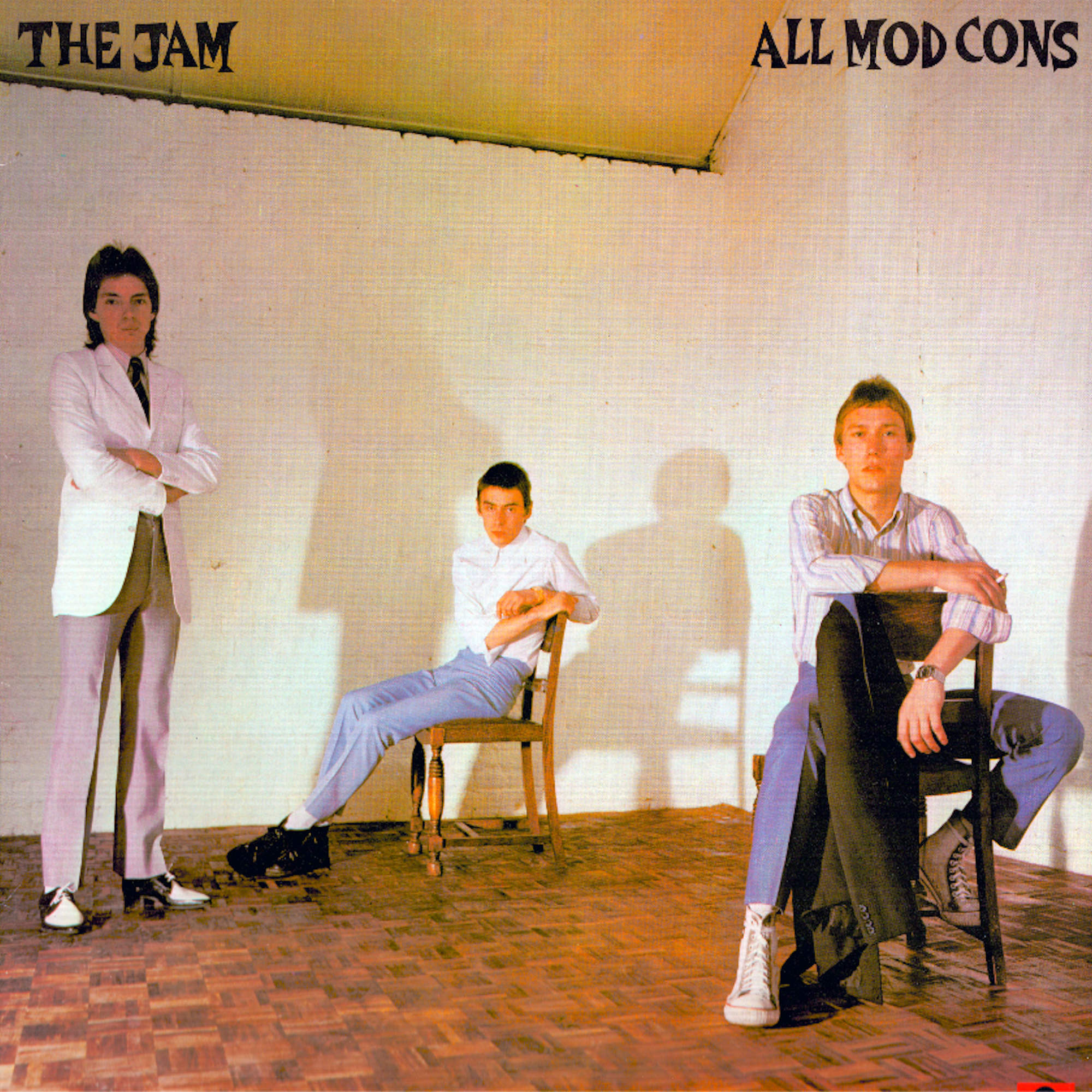
tracks on LP: All Mod Cons / To Be Someone (Didn’t We Have A Nice Time) / Mr. Clean / David Watts / English Rose / In The Crowd / Billy Hunt / It’s Too Bad / Fly / The Place I Love / ‘A’ Bomb In Wardour Street / Down In The Tube Station At Midnight
Record Label: Polydor POLD 5008
Producer: Vic Coppersmith-Heaven
Released: 03/11/78
Purchased: 1980
Third albums generally mean that it’s shut-up-or-get-cut-up time; when an act’s original momentum has drained away and they’ve got to cover the distance from a standing start, when you’ve got to cross “naive charm” off your list of assets.
For The Jam, it seemed as if the Third Album Syndrome hit with their second album. ‘This Is The Modern World’ was dull and confused, lacking both the raging, one-dimensional attack of their first album and any kind of newly-won maturity.
A couple of vaguely duff singles followed and, in the wake of a general disillusionment with the Brave New World, it seemed as if Paul Weller and his team were about to be swept under the carpet.
Well, it just goes to show that you can never tell. ‘All Mod Cons’ is the third Jam album to be released (it’s actually the fourth Jam album to be released; the actual third Jam album was judged, found wanting and scrapped) and it’s not only several light years ahead of anything they’ve done before but also the album that’s going to catapult The Jam right into the front rank of international rock and roll; one of the handful of truly essential rock albums of the last few years.
The title is more than Grade B punning or a clever-clever link up with the nostalgia-buzz packaging (like the target design on the label, the Swinging London trinketry, the Lambretta diagram or the Immediate-style lettering); it’s a direct reference to both the broadening of musical idiom and Weller’s reaffirmation of a specific Mod consciousness.
Remember the Mod ideal; it was a lower-middle class consciousness that stressed independence, fun and fashion without loss of integrity or decent into elitism or consumerism; unself-conscious solidarity and a dollop of non-sectarian concern for others. Weller has transcended his original naivety without becoming cynical about anything other than the music business.
The Jam | All Mod Cons | Polydor | 1978
Mod became hippies and we know that didn’t work; the more exploratory end of Mod rock became psychedelia. Just as Weller’s Mod ideal has abandoned the modern equivalent of beach-fighting and competitive posing, his Mod musical values have moved from ’65 to ’66; the intoxicating period between pilled-up guitar-strangling and ‘Sergeant Pepper.’ Reference points : ‘Rubber Soul’ rather than ‘Small Faces’ and ‘My Generation.’
Still, though Weller’s blends of acoustic and electric 6 and 12-string guitars, sound effects, overdubs and more careful structuring and arranging of songs (not to mention a quantum leap in standard of composition) may cause frissons of delight over at the likes of Bomp, Trouser Press and other covens of ageing Yankee Anglophiles. ‘All Mod Cons’ is an album based firmly in 1978 and looking forward.
This is the modern world: “Down In The Tube Station At Midnight” is a fair indication of what Weller’s up to on this album, as was “A’ Bomb In Wardour Street” (I can’t help thinking that he’s given more hard clear-eyed consideration to the implications of the Sham Army than Jimmy Pursey has), but they don’t remotely tell the whole story.
For one thing, Weller has the almost unique ability to write love songs that convince the listener that the singer is really in love. Whether he’s describing an affair that’s going well or badly, he writes with a penetrating, committed insight that rings perfectly, utterly true.
Weller writes lovingly and (choke on it) sensitively without ever descending to patented-sentimentality that is the stock-in-trade of the emotionally bankrupt. That sentimentality is but the reverse side of the macho coin, and both sides spell lovelessness.
The inclusion of “English Rose” ( a one-man pick ‘n’ croon acoustic number backed only by a tape of the sea) is both a musical and emotional finger in the eye for everyone who still clings to the old punk tough guy stereotype and is prepared to call The Jam out for not doing likewise.
Weller is – like Bruce Springsteen – tough enough not to feel he needs to prove it any more, strong enough to break down his own defences, secure enough to make himself vulnerable. The consciousness of ‘All Mod Cons’ is the most admirable in all of British rock and roll, and one that most of his one-time peers could do well to study.
Through the album, then: the brief, brusque title track and it’s immediate successor (“To Be Someone”) examine the rock business, first in a tart V-sign to some entrepreneurial type who wishes to squeeze the singer dry and then through him away, and second in a cuttingly ironic track about a superstar who lost touch with the kids and blew his career.
The Jam | All Mod Cons | Polydor | 1978
Weller is, by implication, assuring his listeners that no way is that going to happen to him: but the song is so well thought out and so convincing that it chokes back the instinctive “Oh yeah?” that a less honest song in the same vein would elicit from a less honest band.
From there we’re into “Mr. Clean”, an attack on the complacent middle-aged “professional-classes.” The extreme violence of its language the nearest this album comes to an orthodox punk stance, is matched with music that combines delicacy and aggression with an astonishing command of dynamics. This is as good a place to point out that bassist Bruce Foxton and drummer Rick Buckler are more than equal to the new demands that Weller is making on them: the vitality, empathy and resourcefulness that they display throughout the album makes ‘All Mod Cons’ a collective triumph for The Jam as well as a personal triumph for Weller.
“David Watts” follows (written by Ray Davies, sung by Foxton and a re-recorded improvement on the 45) with “English Rose” in hot pursuit. The side ends with “In The Crowd”, which places Weller dazed and confused in the supermarket. It bears a superficial thematic resemblance to “The Combine” (from the previous album) in that it places its protagonist in a crowd and examines his reactions to the situation, but its musical and lyrical sophistication smashes “The Combine” straight back to the stone age. It ends with a lengthy, hallucinatory backward guitar solo which sounds as fresh and new as anything George Harrison or Pete Townshend did a dozen years ago, and a reference back to “Away From The Numbers.”
“Billy Hunt”, whom we meet at the beginning of the second side, is not a visible envy-focus like Davies’ “David Watts”, but the protagonist’s faintly ludicrous all-powerful fantasy self; what he projects in the day dreams that see him through his crappy job. The deliberate naivety of this fantasy is caught and projected by Weller with a skill that is nothing short of marvellous.
A brace of love songs follow: “It’s Too Bad” is a song of regret for a couple’s mutual inability to save a relationship which they both know is infinitely worth saving. Musically, it’s deliriously wonderfully ’66 Beat Groupish in a way that represents exactly what all those tinpot powerpop bands were aiming for but couldn’t manage. Lyrically, even if this sort of song was Weller’s only lick, he’d still be giving Pete Shelley and all his New Romance fandangos a real run for his money.
The Jam | All Mod Cons | Polydor | 1978

“Fly” is an exquisite electric / acoustic construction, a real lovers’ song, but from there on in the mood changes for the “Doctor Marten’s” Apocalypse of “A-Bomb In Wardour Street” and “Tube Station”. In both these songs Weller depicts himself as the victim who doesn’t know why he’s getting trashed at the hands of people who don’t know why they feel they have to hand out the aggro.
We’ve heard a lot of stupid, destructive songs about the alleged joys of violence lately and they all stink; if these songs are listened to in the spirit in which they were written then maybe we’ll see a few less pictures of kids getting carried off the terraces with darts in their skulls. And if these songs mean that one less meaningless street fight gets started then we’ll all owe Paul Weller a favour.
The Jam brought us the Sound of ’65 in 1976, and now in 1978 they bring us the sound of ’66. Again, they’ve done it in such a way that even though you can still hear The Who here and there and a few distinct Beatles-isms in those ornate descending 12-string chord sequences, it all sounds fresher and newer than anything else this year.
‘All Mod Cons’ is the album that’ll make Bob Harris’ ears bleed the next time he asks what has Britain produced lately; more important, it’ll be the album that makes The Jam real contenders for the crown.
Look out, all you rock and rollers: as of now The Jam are the one’s you have to beat. (NME, 28/10/78)

“No matter where I roam, I will return to my English Rose.” Soft acoustic guitar, gentle vocals. The waves and wind create an atmospheric background. Not what you’d expect from the Jam, but this beautiful ballad is one of the highlights of their progressive third album. Forget the crash, bang, wallop revivalist style of their early days; The Jam have come of age.
Paul Weller’s songwriting has taken on a new mature subtlety, which adds constant variety to this powerfully melodic album.
The opening three tracks show that the band have not lost any of their youthful energy, but it is now controlled, making for a longer lasting enjoyment. The short sharp title track shows that the sixties influence still remains. But who cares, they are not imitators but upholders of a Great British tradition.
This is sixties music handled in an original and modern way, which has given The Jam their distinctive and now truly distinguished style.
On “To Be Someone” Weller attacks trendy superstars while on “Mr. Clean” hypocritical businessmen are the subject of his angry lyrics. “David Watts” follows, being the most commercial song on the album and as such is perhaps the most disposable.
The Jam | All Mod Cons | Polydor | 1978
“English Rose” is not credited on the record cover or lyric sheet but thank goodness it is on the vinyl. With its simple romantic lyrics this song clearly shows the new found scope of Weller’s songwriting. The side closes on a high with the hypnotic “In The Crowd.”
On to Side Two which opens with the fast and furious “Billy Hunt”. However The Jam have now slowed down and now concentrate on carefully constructed arrangements, which make them far from one dimensional.
“It’s Too Bad” and “The Place I Love” are pure Beatles-ish pop songs. The romantic “Fly” adds further polish to this successfully diverse album. It ends with the aggressive “A-Bomb In Wardour Street” and “Down In The Tube Station At Midnight”. Both conjure up frighteningly realistic visions of violence.
“I glanced back on my life, I thought about my wife.
‘Cause they took the keys and she’ll think it’s me.”
No clever final comments, just that this is one of three albums of ’78. ***** (Record Mirror, 04/11/78)

Leave a Reply