
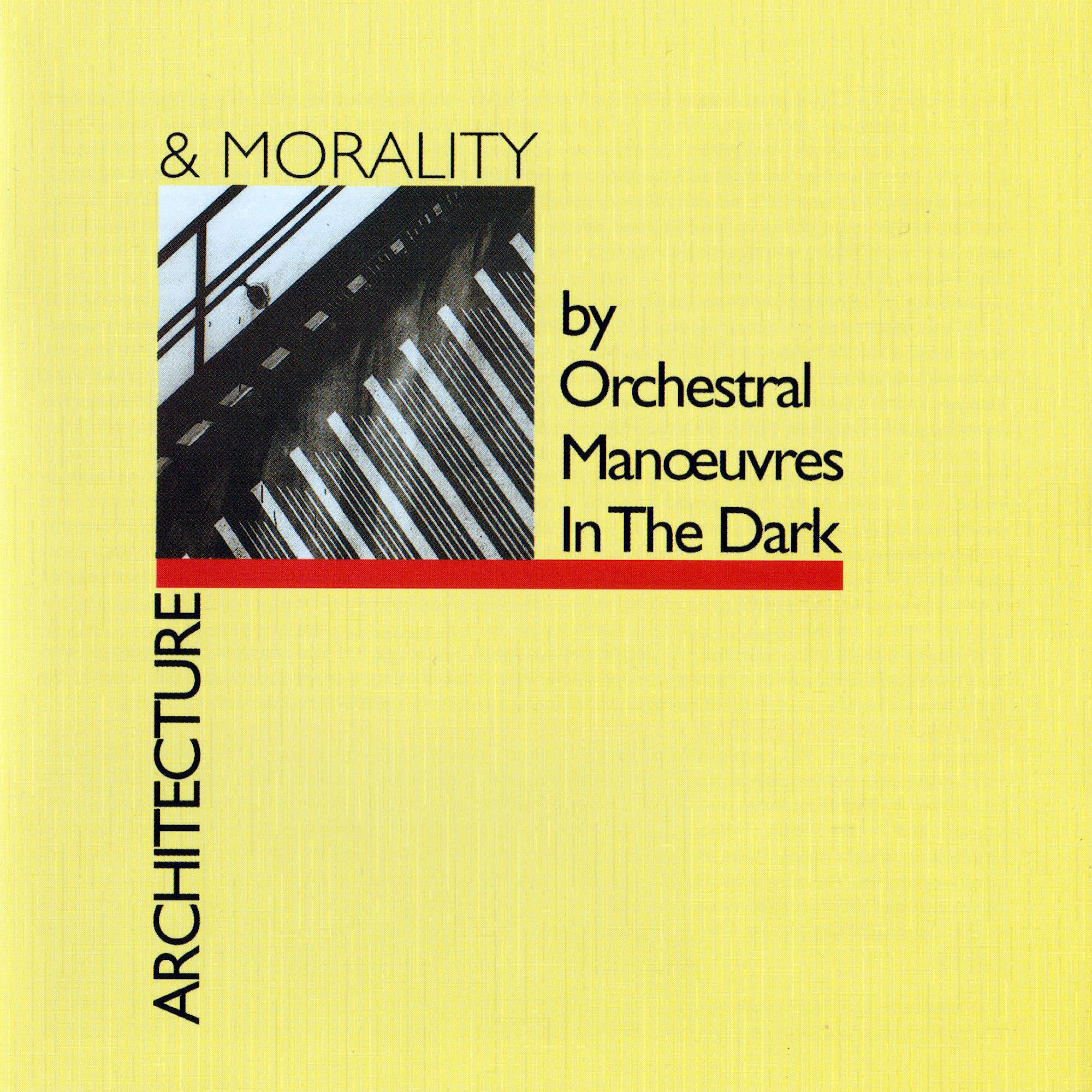
tracks on LP: The New Stone Age | She’s Leaving | Souvenir | Sealand | Joan Of Arc | Joan Of Arc (Maid Of Orleans) | Architecture & Morality | Georgia | The Beginning And The End
Record label: Dindisc DID 212
Released: November 1981
Borrowed: 1981 (Keith Lowery)
OMD | Architecture & Morality | (Dindisc) 1981 | Now this is definitely more like it. The good news here is that for their crucial third album OMD have chosen to play to their greatest strength—producing strong melodies with concise rhythms and interesting lyrics—while disciplining their more adventurous leanings into producing some fascinating arrangements that actually complement the songs rather than simply distorting them or smothering them beyond memorability.
Thus effectively directed, the band’s channelled energies now also help to achieve some of the impact of a live performance and the result is at once OMD’s most attractive, most effective and most sophisticated performance to date. At the same time, liberal splashings of choral effects plus some low key mellotrons and guitar give this album its own distinctive character.
Hits? You bet. Besides “Souvenir” there are two obvious lush, melodic candidates, both confusingly called “Joan Of Arc” (and even more confusingly both to be released as singles this month). The classic simple melancholy of “She’s Leaving” is a dead cert, while the janglebox appeal of “Georgia” could also steal home.
Of the more challenging material, “New Stone Age” makes an excellent opener, haunted nerve-end urgency and a reminder that the distance between OMD and Joy Division is not as great as it might seem. “Sealand” is the logical progression from “Stanlow”, extended but accessible, while “Architecture And Morality” itself is an ambitious attempt at translating feelings into form, one that the pop fans won’t want to try to understand.
This just leaves the album’s sole weak point, “End And The Beginning”—a ballad that never gets going and makes for an unfortunate anti-climax of a closer. Quick, back to side one!
All in all, not least given the current vogue for hip musical junk food that aims low (and misses), “Architecture And Morality” shines out like a veritable beacon of tasteful, intelligent, creative talent. (The Face, November 1981)

OMD | Architecture & Morality | (Dindisc) 1981
Hallelujah! OMD are literally back on song, reigning in their more ambitious ideas into concise but varied and imaginative arrangements that actually boost instead of swamp their wonderful melodies and intelligent lyrics.
Choral effects galore, mellotrons and sparing guitar all contribute to a distinctive and fuller sound without detracting from the impact, and the result is both four more potential hits besides “Souvenir” and the bands most impressive achievement to date. (Smash Hits, November 1981)

Paul Humphries and Andy McCluskey are purveyors of dreams and atmosphere, the more ethereal of their compositions exuding and unreal, faraway quality which has earned them as much respect and following as their well crafted, infectious pop songs.
Orchestral Manoeuvres LPs should be judged on their ability to affect, rather than by the competence of each individual song. Certain compositions on ‘Architecture And Morality’ are unable to stand up on their own, but taken in context as part of a succession of songs, they form a valid contribution to the overall effect.
Orchestral Manoeuvres succeed through trial and error, sometimes failing to get the complete point across. What matters though, is the emotion and atmosphere they pour into their work, so much that their songs conjure vivid visual images.
This still holds true in this, their third LP, but perhaps it is more of a puzzle than its predecessors. It is not so blatantly poppy as the first album, nor is it as overtly bleak as ‘Organisation’. And because it falls between creating one overall mood and a collection of classic pop – ‘Architecture And Morality’ requires more effort on the listener’s part before the layers and textures can be enjoyably recognised and the puzzle solved.
More diverse than anything they’ve previously attempted, ‘Architecture And Morality’ evokes various styles, dreamy, poppy, even synthesised R&B (“Georgia”).
For instance, there’s two versions of “Joan Of Arc”. One is the single, the other subtitled “Maid Of Orleans” – is very Celtic in its composition in keeping with its subject, with synthesisers resembling uilleann pipes and a drum role akin to a battle march.
The trio on side one – “She’s Leaving”, “Souvenir” and “Sealand” – bring out so much atmosphere that they could have been written as a film soundtrack; what is perhaps more interesting is that before identifying each song with its title, “Sealand” did in fact inspire visions of seascape within me.
The title track is as pompous and pretentious musically as it is literally, and the closing composition “The Beginning And The End” is disappointing in its lack of depth.
Although I has misgivings initially, ‘Architecture And Morality’ is no disappointment. In the Dark by name, but most definitely not by nature. ++++ (Record Mirror 07/11/81)

Leave a Reply