
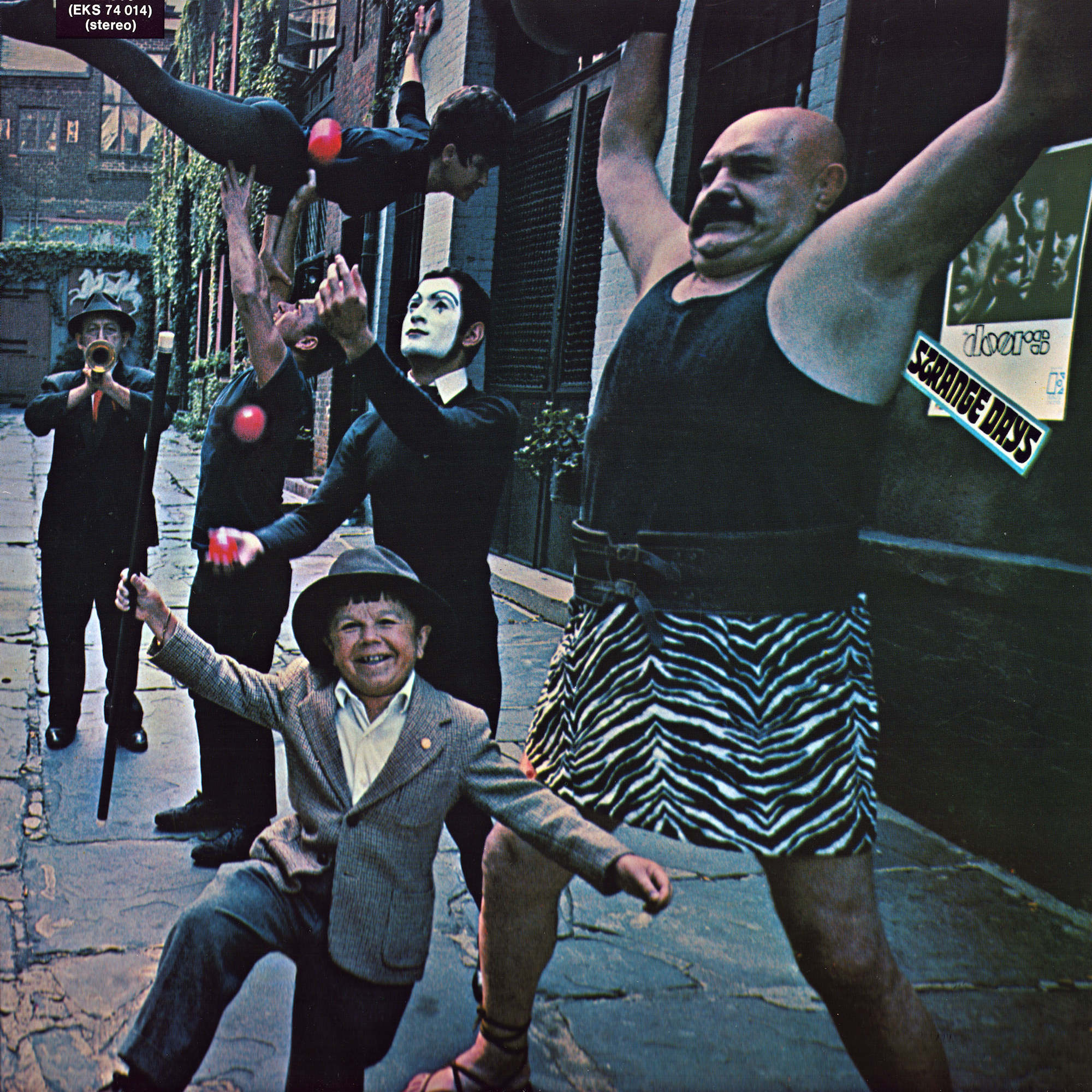
tracks on LP: Strange Days | You’re Lost Little Girl | Love Me Two Times | Unhappy Girl | Horse Latitudes | Moonlight Drive | People Are Strange | My Eyes Have Seen You | I Can’t See Your Face In My Mind | When The Music’s Over
Record label: Elektra EKL-4014
Released: 25/09/67
Borrowed: 28/04/84 (Ian Baxter)
The Doors | Strange Days | (Elektra) 1967 | Strange Days is the second studio album by the American rock band the Doors, released on September 25, 1967 by Elektra Records. Arriving eight months after the successful release of their self-titled debut album, on this record the band started experimenting with both new and old material in early 1967. Upon release, Strange Days reached number three on the US Billboard 200, and eventually earned a platinum certification from the Recording Industry Association of America (RIAA). It contains two Top 30 hit singles, “People Are Strange” and “Love Me Two Times”.
Despite the album’s failure to match the success of its predecessor, it was “arguably the one the band itself most appreciated musically and creatively”, according to David V. Moskowitz.
Strange Days was recorded during tour breaks between February and August 1967 at Sunset Sound Recorders in Hollywood (the same studio as their first LP). In contrast to the 1966 sessions, producer Paul A. Rothchild and engineer Bruce Botnick employed a then cutting-edge 8-track recording machine. The protracted sessions allowed the band to experiment in the studio and further augment their sound with unusual instrumentation and sonic manipulation. Botnick said that the Doors were determined to pursue “new techniques of recording. No holds barred.”
The Doors | Strange Days | (Elektra) 1967
Unlike The Doors, Strange Days incorporates various instruments, ranging from marimba to Moog synthesizer, which has been described as one of the first uses of the synth in rock music history. The contribution of the synthesizer was programmed with the help of Paul Beaver and played by lead singer Jim Morrison. Session musician Doug Lubahn occasionally played bass during the recording of the album.
Also recorded during the album sessions are the songs “Summer’s Almost Gone” and “We Could Be So Good Together”, both of which were ultimately left off the album but included on the subsequent album, Waiting for the Sun in 1968.
Several of the album’s songs had been written around the same time as the ones that appeared on The Doors. Two (“My Eyes Have Seen You” and “Moonlight Drive”) had been demoed in 1965 at Trans World Pacific Studios before Robby Krieger joined the group; indeed, the latter had been conceived by Morrison prior to his fateful reunion with Manzarek in the summer of 1965. Although the song was attempted twice during the sessions for the band’s debut, both versions were deemed unsatisfactory. A conventional blues arrangement, “Moonlight Drive” features a defining slightly off-beat rhythm and Krieger’s bottleneck guitar, which create an eerie sound.
The LP’s first single, “People Are Strange”, was composed in early 1967 after Krieger, drummer John Densmore, and a depressed Morrison had walked to the top of Laurel Canyon. Densmore recalled the song’s writing process in his book Riders on the Storm: Densmore and Krieger, who had then been roommates, were visited by a seemingly dejected Morrison. At the suggestion of Densmore, they took a walk along Laurel Canyon. Morrison returned from the walk “euphoric” with the early lyrics of “People Are Strange”.
Although Morrison was the Doors’ primary songwriter, Krieger wrote several of the group’s hit singles, with his first composition being “Light My Fire”. His bluesy “Love Me Two Times” was about a soldier/sailor on his last day with his girlfriend before shipping out, ostensibly to war. Manzarek said lyrically the song can be about “lust and loss, or multiple orgasms, I’m not sure which.”
Manzarek played the final version of this song on a harpsichord, which Manzarek described as “a most elegant instrument that one does not normally associate with rock and roll.” It was edited to a 2:37 length and released as the second single (after “People Are Strange”) from the album, and reached No. 25 on the charts in the US. Upon release, “Love Me Two Times” was considered to be somewhat risqué for radio airplay, and was banned in New Haven, Connecticut, for being “too controversial”, much to the dismay of the band.
The Doors | Strange Days | (Elektra) 1967
“Horse Latitudes” showcases Morrison’s spoken-word poetry, who confirmed that he penned the poem during his high school years. However, Manzarek had mentioned that he never believed he wrote “Horse Latitudes” at such a young age, claiming the words were “too mature”. The album concludes with the 11 minute-long epic, “When the Music’s Over”, whose keyboard part was inspired by Herbie Hancock’s “Watermelon Man”.
Strange Days was released on September 25, 1967, by Elektra Records. Although the album was quite successful, reaching No. 3 in the United States during a sixty-three-week chart stay in November 1967, its impact was attenuated by the enduring success of the band’s debut album, which remained in the Top Ten over ten months after its release during a 122-week stay
The album cover of Strange Days, photographed by Joel Brodsky, depicts a group of street performers in New York. The location of the photograph is at Sniffen Court, a residential alley next to East 36th Street between Lexington and Third Avenue in Manhattan. Actual street performers could not be located for all of the designated roles, so Brodsky’s assistant stood in as a juggler while a random cab driver was paid $5 to pose playing the trumpet. Twin dwarfs were hired, with one appearing on the front cover and the other appearing on the back cover, which is the other half of the same photo on the front cover.
A group shot of the band appears on a poster in the background of both covers, bearing captions of the band and album name. (The same photograph previously appeared on the back cover of the band’s debut album.) Because of the subtlety of the artist and album title, most record stores put stickers across the cover to help customers identify it more clearly.[Wikipedia]

Leave a Reply