
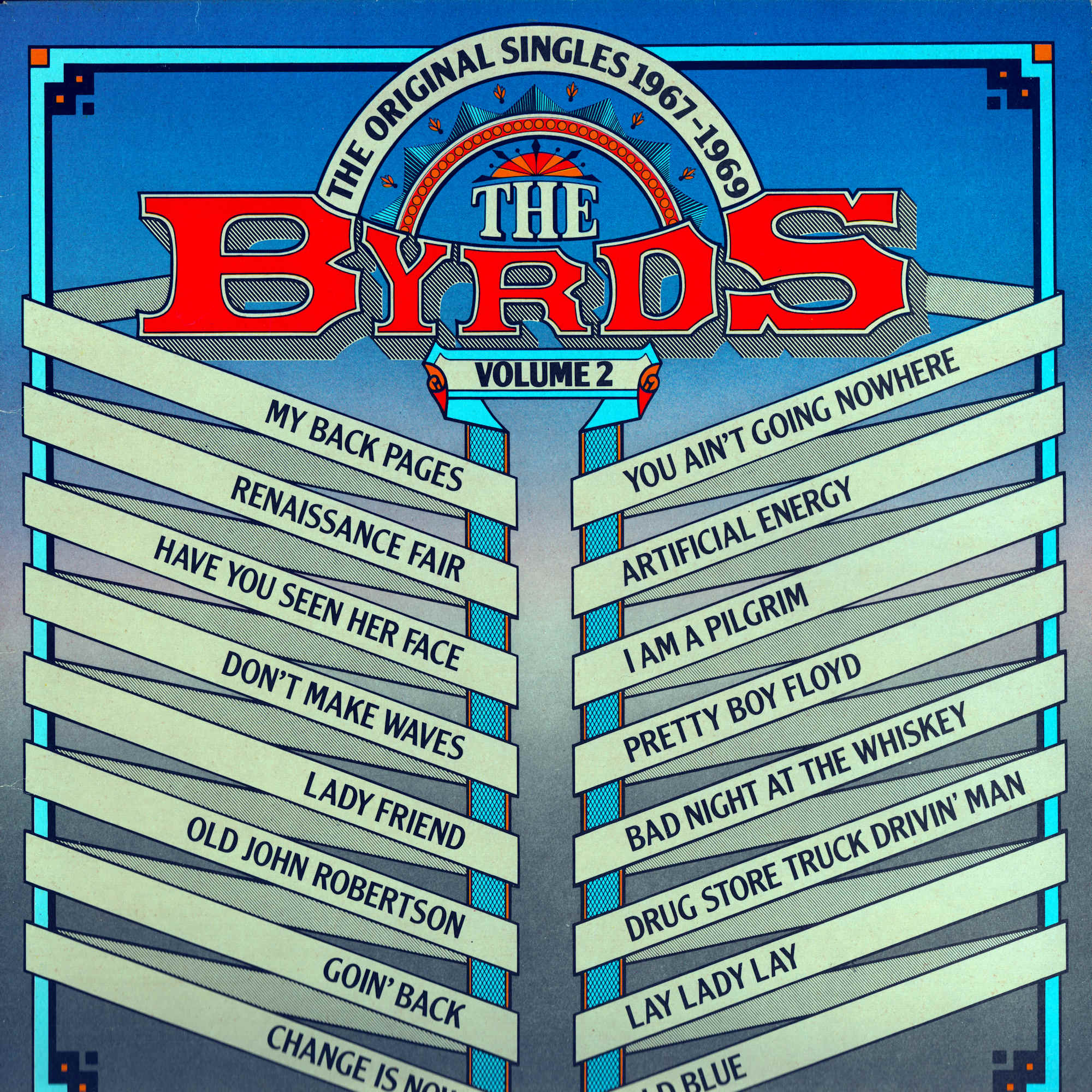
tracks on LP: My Back Pages, Renaissance Fair, Have You Seen Her Face, Don’t Make Waves, Lady Friend, Old John Robertson, Goin’ Back, Change Is Now, You Ain’t Going Nowhere, Artificial Energy, I Am A Pilgrim, Pretty Boy Floyd, Bad Night At The Whiskey, Drug Store Truck Drivin’ Man, Lay Lady Lay, Old Blue
Record label: CBS Records 32103
Released: April 1982
Purchased: 28/08/82
This second volume of The Byrds Original Singles presents another magnificent run of tracks covering the years 1967-1969. What is most remarkable about these cuts is the rich musical diversity of the material. Having pioneered folk-rock and raga-rock, The Byrds moved into the psychedelic era with two brilliant albums, Younger Than Yesterday and The Notorious Byrd Brothers gradually assimilating a stronger country influence along the way.
The music on this album is evidence enough of The Byrds continuing musical experimentation during the final years of the Sixties. The opening cut, “My Back Pages”, provided the group with an important Top 30 hit and helped to establish their standing as one of the best interpreters of the music of Bob Dylan. The flip-side of that single “Renaissance Fair” was, in many respects, even more intriguing. Written mainly, if not entirely, by David Crosby, the song was a vivid evocation of one of the very first love-ins. The Renaissance Fair was a mock medieval festival sponsored by one of the LA radio stations in which the participants dressed themselves in twelfth century costume.
“Have You Seen Her Face”, like the previous two cuts, was taken from Younger Than Yesterday and released as a single in the States. The song was most notable for the sudden emergence of Chris Hillman as both a singer and songwriter of great charm and wit. His subsequent contributions had a distinct McCartneyesque flavour, which served as an effective contrast to the more ambitious work of McGuinn and Crosby.
The Byrds | The Original Singles 1967 – 1969 | CBS 1982
The rivalry between McGuinn and Crosby was causing enormous problems during the second half of 1967. Events reached a head at the Monterey Pop Festival when Crosby played alongside the Buffalo Springfield, an act which the other Byrds interpreted as open defiance. By the end of the Festival The Byrds had effectively split into two factions and it was clear that the months ahead would be stormy.
The year ended with Crosby being fired from the group and drummer Michael Clarke retiring to Hawaii, leaving The Byrds to ponder their future as a duo! It was during these turbulent months that several songs were issued on singles that were destined to become the rarest of Byrds tracks on record.
Avid collectors of Byrds material will no doubt stare in disbelief at the cuts assembled here for the first time in album form. “Don’t Make Waves”, written for an MGM movie starring Claudia Cardinale and Tony Curtis failed to qualify for a place on The Notorious Byrd Brothers. A more surprising omission from that album was Crosby’s startling “Lady Friend”, one of the finest songs he ever wrote. The theme, concerning the fragmentation of a broken relationship, was typical 1967 Crosby but the inclusion of brass gave the song even greater momentum than his earlier efforts.
The U.S. flip-side of “Lady Friend”, “Old John Robertson”, was a different cut from the version that appeared on The Notorious Byrd Brothers and apparently included Crosby on backing vocals. While The Byrds lay in ruins at the end of 1967 CBS issued a Christmas single in the form of “Goin’ Back/Change Is Now”. The former had been a sizeable hit for Dusty Springfield the previous year but The Byrds totally transformed this Coffin and King composition and made the song their own.
The ironically titled, “Change Is Now” proved conclusively that in spite of all the changes The Byrds were still capable of producing consistently brilliant work. Although The Byrds only released two singles in 1968, the year was anything but uneventful. In March, Gram Parsons joined the group while they were intent upon recording an electronic-jazz album.
Almost immediately, however, Parsons demonstrated his strong influence on The Byrds by encouraging them to record an album of country music. The extent of his influence was evident on their next single, “You Ain’t Going Nowhere”. In many ways it was very much in the old Byrds tradition being an unreleased Dylan song and featuring McGuinn on lead vocal. However, the strong use of the steel-guitar provided clear clues as to where The Byrds were heading under the influence of Gram.
The flip-side of that single “Artificial Energy”, was a reminder of their more innovative work during the previous year. Written mainly by Chris Hillman as a creed against speed, the track was full of subtleties with an array of musical instruments and electronic wizardry.
The Byrds | The Original Singles 1967 – 1969 | CBS 1982
When Parsons quit The Byrds on the eve of their abortive South African tour, the group all but disintegrated during the remainder of the year. “I Am A Pilgrim” and “Pretty Boy Floyd” (both taken from Sweetheart of The Rodeo) showed strong traditional leanings characteristic of the Parsons regime. It took all of McGuinn’s courage and tenacity to keep The Byrds together after the upheavals of the previous twelve months, but he gallantly soldiered on.
The debut single of the new look Byrds proved that McGuinn’s efforts had not been wasted. “Bad Night At The Whiskey”, co-written by Joey Richards whom Roger had known through the religious organization Subud, remains one of the great neglected Byrds songs. Musically, the song hinted that The Byrds might be moving towards a heavier, more intricate guitar sound but the idea was undeveloped.
The contrasting flip-side “Drug Store Truck Driving Man” was equally intriguing outshining many of the tracks on Sweetheart of The Rodeo. Co-written with Gram Parsons in London, just prior to the South African disaster, it was a satiric riposte to the Nashville audience who had rejected The Byrds.
The final two cuts on this album again revealed The Byrds exploring new musical ideas. The girl chorus used on “Lay Lady Lay” indirectly prepared us for the Byrds gospel sound while “Ole Blue” confirmed their increasing interest in country rock. The 16 tracks on this album demonstrate the remarkable range of The Byrds’ talent at every stage of their career. (JOHNNY ROGAN)

Leave a Reply