
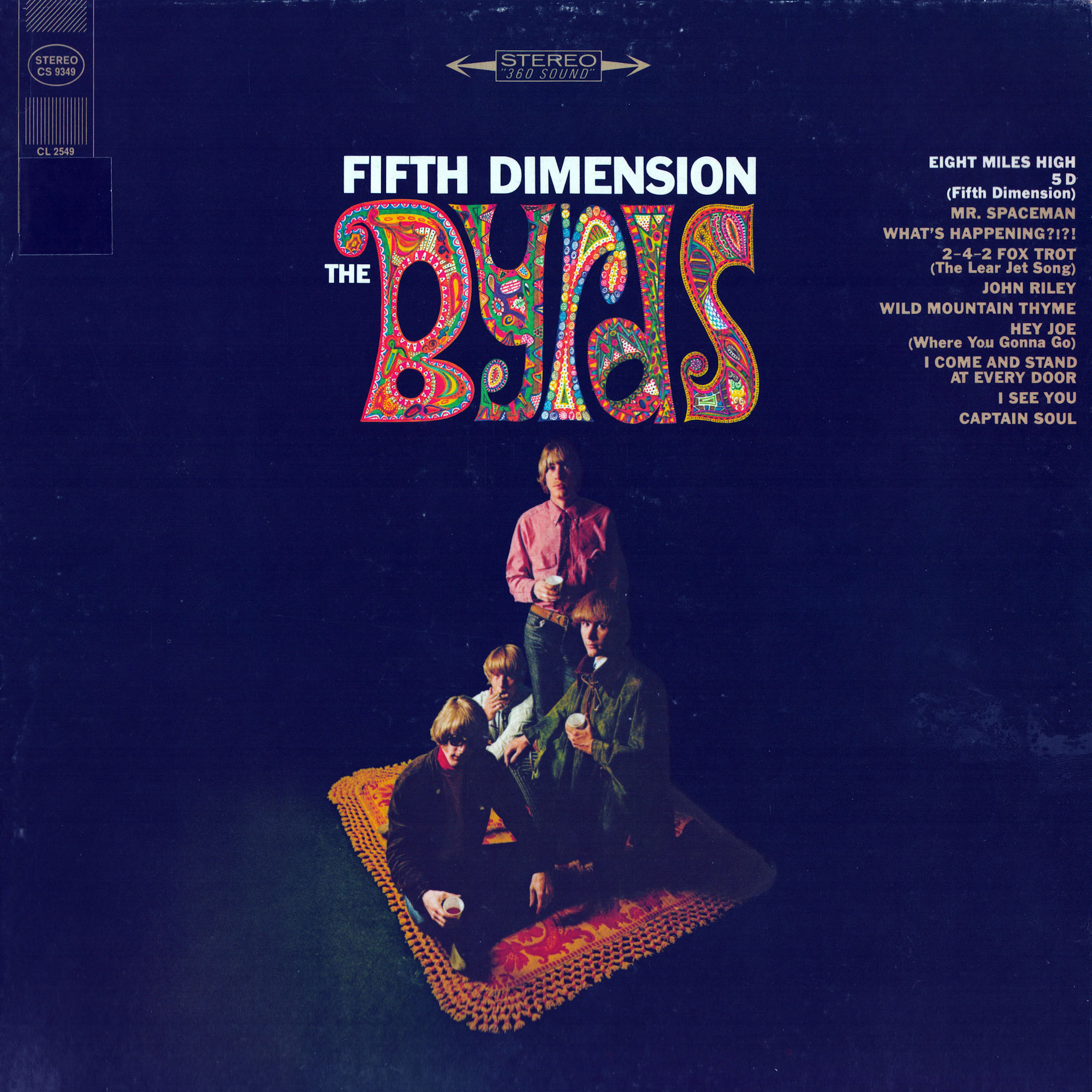
tracks on LP: 5D (Fifth Dimension) | Wild Mountain Thyme | Mr. Spaceman | I See You | What’s Happening?!?! | I Come And Stand At Every Door | Eight Miles High | Hey Joe (Where You Gonna Go) / Captain Soul | John Riley | 2-4-2 Fox Trot (The Lear Jet Song)
Record label: Columbia CS 9349
Released: 18/07/66
Purchased: 07/06/83
In the days before “Mr. Tambourine Man”—before the Byrds were blindsided by fame, fortune and fast living—Roger McGuinn and David Crosby spent a lot of their free time under the jet stream at Los Angeles International Airport, gazing at the planes overhead as they landed in elegant, almost mathematical succession. It was cheap entertainment and, for two aviation enthusiasts with big flight plans of their own, a kind of spiritual rush. McGuinn and Crosby even wrote a song based in part on those long, lazy reveries at LAX, a feathery ballad of longing and sweet reunion entitled “The Airport Song,” and recorded by the Byrds during their shakedown demo sessions at World Pacific Studios in 1964.
“It was a real kick to watch these planes come over,” McGuinn recalled years later. “We used to go out to Airport Boulevard and park right under the runway. Runway 25. Airport Boulevard goes right under the final approach. In fact, Peter Fonda swiped our location for Easy Rider. The opening scene where Phil Spector is in his Rolls Royce doing a dope deal —that was our location.”
The Byrds never returned to “The Airport Song” after signing with Columbia; it was one of several early, naive originals left behind in favor of the Dylan covers and the new beauties from Gene Clark’s pen. But the flying dreams, the long-distance yearning, the dramatic sensations of supersonic motion and midair suspension—they all became thematic staples of Byrdsong, important metaphors for a band driven by lofty ambition.
As musicians, songwriters and pop stars in an age of moon shots and acid tests, the Byrds were nothing if not true to their name. Fifth Dimension caught McGuinn, Crosby, Chris Hillman and Michael Clarke halfway between tradition and the wild blue yonder, juxtaposing the public-domain romanticism of ‘Wild Mountain Thyme” with McGuinn’s interstellar hitchhiking cartoon “Mr. Spaceman.” It was a schizophrenia partly born of necessity: 5D, as the album came to be known, was the Byrds’ first Dylan-free effort and their first without Gene Clark, who left shortly before recording commenced in late April of 1966.

The surviving members’ overreliance on coffeehouse standards such as ‘Wild Mountain Thyme” and “John Riley” and the addition of underwhelming filler like the so-called “Lear Jet Song”—”song” was a rather generous description of one lightweight hook and two minutes of cockpit-radio chatter—certainly smacked of deadline pressure and a thinned-out repertoire. (Clark continued to pop into the studio; that’s his harmonica on the vanilla-R&B instrumental “Captain Soul.”)
But as awkward and scattered as it may have seemed at the time, Fifth Dimension—especially in this generously expanded edition—is actually a record of considerable beauty and great courage, an impressive display of shotgun enthusiasm. The strings on ‘Wild Mountain Thyme” and “John Riley” bring a touch of Old World grandeur to the Byrds’ electric archaeology. “Mr. Spaceman” is a prescient blast of rock & roll Nashville, predating the Opry realism of Sweetheart Of The Rodeo by almost two years.
As a guitarist, McGuinn had evolved light years beyond the Bach-ish propriety of “Mr. Tambourine Man.” His electric 12-string meltdowns in “Eight Miles High” and “I See You” boil over with nervous energy and harmonic bravado, reflecting the Byrds’ prolonged exposure to the Indian sitar master Ravi Shankar and the visionary saxophonist John Coltrane (his records were regulars on the Byrds’ tour-bus in 1965).
And while Crosby’s brash attempt at “Hey Joe” isn’t quite as sharp as earlier covers by Love and the Leaves, you have to admire the vengeful spunk with which Crosby—who claimed to have discovered the classic murder ballad—retakes the song for himself.
Written and recorded at the turn of ’65/66, during Clark’s last months with the band, “Eight Miles High” was the quantum leap from folk-rock formalism —and that goes for both versions (the legendary RCA Studio version has a slight edge in terms of live feel and the explosive articulation of McGuinn’s playing). The song’s open-ended, mantra-like lyricism, charged by the jagged modality of McGuinn’s solos, shattered the verse-chorus-verse tyranny of Top 40 tunecraft and defined the sound and ideal of psychedelia at a time when the Beatles had only just digested the lessons of folk-rock on Rubber Soul.
That cliffhanging quality of unresolved melodic drama, also exploited to compelling effect on “Why” and “I See You,” became a trademark of Crosby’s writing in particular, taken to its space-iest extreme on his 1971 solo album If I Could Only Remember My Name’. At the same time, the agitated liberties McGuinn took with his Rickenbacker even on something nominally conventional as “John Riley” – check out the previously unissued, instrumental version included here—show how easily, and potently, the Byrds’ dynamic futurism could be applied to a simple chord progression and swinging rhythm.
It seems laughably quaint now that “Eight Miles High” was widely perceived as a song about drugs (as opposed to a song, allegedly, written on drugs). In fact, “Eight Miles High”—rife with subtle but unmistakeable details of the Byrds’ flight to London in August 1965—nailed the paradox of elevation and tailspin, the beauty of soaring and the fear of falling, with an eerie clarity that reverberated throughout Fifth Dimension.
It was surely no accident that Side One of the original LP began with McGuinn’s wry blend of playful science and doomsday prophecy in the title title track and ended with the soft-spoken horror of “I Come And Stand At Every Door,” the soliloquy of a young child incinerated at Hiroshima. It was only 1966, but here was the hard lesson of the decade in a nutshell, what goes up must come down, sometimes with crushing force.
The Byrds themselves made Fifth Dimension in the combined spirit of euphoria and uncertainty. If there is a case to be made for the band’s defining influence on American rock, especially the post-punk underground of the 1980s, it is not the jangly classicism of “Mr. Tambourine Man” but in this album’s liquid energy, its volatile expression of adventure, risk and self-examination. (CD liners)

Leave a Reply