
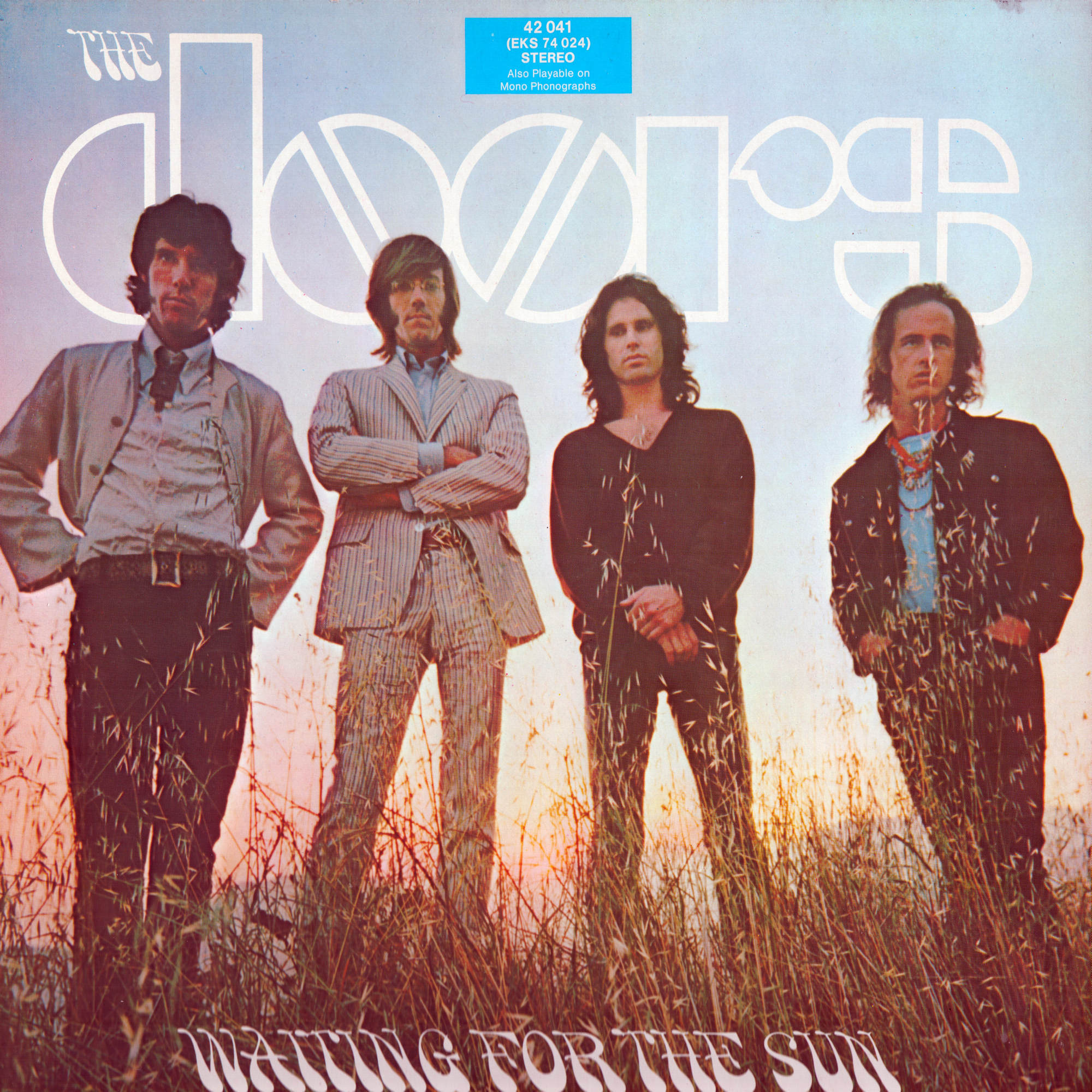
tracks on LP: Hello, I Love You | Love Street | Not To Touch The Earth | Summer’s Almost Gone | Wintertime Love | The Unknown Soldier | Spanish Caravan | My Wild Love | We Could Be So Good Together | Yes, The River Knows | Five To One
Record label: Elektra 42 041 (1980 re-issue)
Released: 07/68
Purchased: 30/07/83
Waiting For The Sun (Elektra EKS 74024) 7/68 | After a year and-a-half of Morrison’s posturing, one might logically hope for some sort of musical growth, and if the new record isn’t really terrible, it isn’t particularly exciting either. The group, as always, is tight: Manzarek does some nice things on keyboards and Krieger acquits himself quite capably on guitar; the rhythm section (particularly Densmore) leaves something to be desired in the way of swing, but at least everybody is together. The songs vacillate between the trivial and the neo-Freudian, reaching in some cases new depths as far as lyrics go — Rolling Stone, 28/9/68
The Doors are schizoid. They proclaim their revolt against convention while their music seldom transcends the ordinary. Their lyrics sing of freedom, spontaneity, and the absurd, but I find their music too tight, controlled, and contrived to express those feelings . . . For example, ‘We Could Be So Good Together’ (a song recorded some time ago but included on their new album) is over-arranged so that everything, including those cute little breaks, is predictable. We expect more from this group…
Krieger, Manzarek and Densmore don’t move in new directions, and instead give us a restatement of The Doors’ basic style, presented on their first album. Krieger is the best of the three . . . They are unable to express the kinds of feelings Morrison seems to be singing about . . .
Judged by conventional standards, he is a vocalist of limited virtues. Every song is sung in the same droning style . . . I find him most effective when he does simple material. Consequently, ‘Hello, I Love You’ and ‘Love Street’ (the two sides of their recent hit single) are his best efforts on the album. Both are relatively uncomplicated, the former straight rock and the latter one of the most successful melodies The Doors have created. They are the album’s highlights —Eye, November 1968
Another pretentious attempt at S&M erotica from The Doors, America’s Number One group — American Record Guide, October 1968
Their third album represents a continuation of the group’s musical logo — Manzarek’s well-executed organ and piano work and Morrison’s heavy, husky vocal delivery. Lyrically and musically The Doors present an existential world consisting solely of sex, drugs and revolution, usually thematically intertwined. Both sides begin with lightweight songs — ‘Hello, I Love You’ (a top 40 success) and ‘Spanish Caravan’ — pleasant but not much else.
Perhaps they are necessary to relieve the heaviness of some of the other cuts . . . It’s obvious that they are musically indebted to Weill on all of their albums. While they are not as overtly political as Brecht, The Doors share his preoccupation with revolution, chaos and the existential absurdities. I can’t say that I enjoy The Doors’ music (and I am impatient with their apparent reluctance to continue the experiment they began), rather I continue to be fascinated with their ability to portray the nightmare ugliness of our various realities’ —Jazz & Pop, December 1968

Everyone — well, almost everyone — keeps telling me that The Doors are a really good group. So I listened again. And half of once again. Still they escape me, as entertainers or even as a group with shock value. In person, supposedly, they are impressive as ‘erotic politicians’, offering performances that reportedly have teenyboppers moistening all over. On records, they strike me as a vastly overpraised group, notable for a furious urgency and very little else’ – Stereo Review, June 1969
The tension between The Doors as a pop band and something more profound is at its most jarring on their unfocused third effort, which reflects their move from clubs to arenas. It opens with the derivative, shallow US #1 ‘Hello, I Love You’ and pretty, vacuous ‘Love Street’, before veering into more adventurous waters with mystical tracks like ‘Yes, The River Knows’ and the terrific hard-rocker ‘Not To Touch The Earth’.
In the context of these, Morrison’s revolutionary posturing on ‘The Unknown Soldier’ and ‘Five To One’ seems incongruous, even laughable. Elsewhere there’s a hotch-potch of tracks, some better than others, but none as good as the best things on their previous LPs. Robby Krieger contributes some astounding guitar runs to ‘Spanish Caravan’, but Ray Manzarek’s deft organ work often sounds frustratingly weedy. (RMJ)
I find this much more successful and interesting than Strange Days. It’s not without annoying moments (‘Unknown Soldier’ should never have seen the light of day, and the big hits ‘Hello, I Love You’ and ‘Five To One’ don’t do a great deal for me), but ‘Summer’s Almost Gone’ is a strong, evocative workout, with Krieger’s subtle guitar adding to the mournful vibe, ‘Yes, The River Knows’ is an effective, gentle, crooning ballad, the more energetic ‘Spanish Caravan’ has some good ideas, and so does the more abrasive ‘Not To Touch The Earth’.
Nonetheless, you can’t help feeling that there’s some kind of transition going on here, as if they’ve moved on from the past and have an eye on what was to come next. (JE)

Leave a Reply