
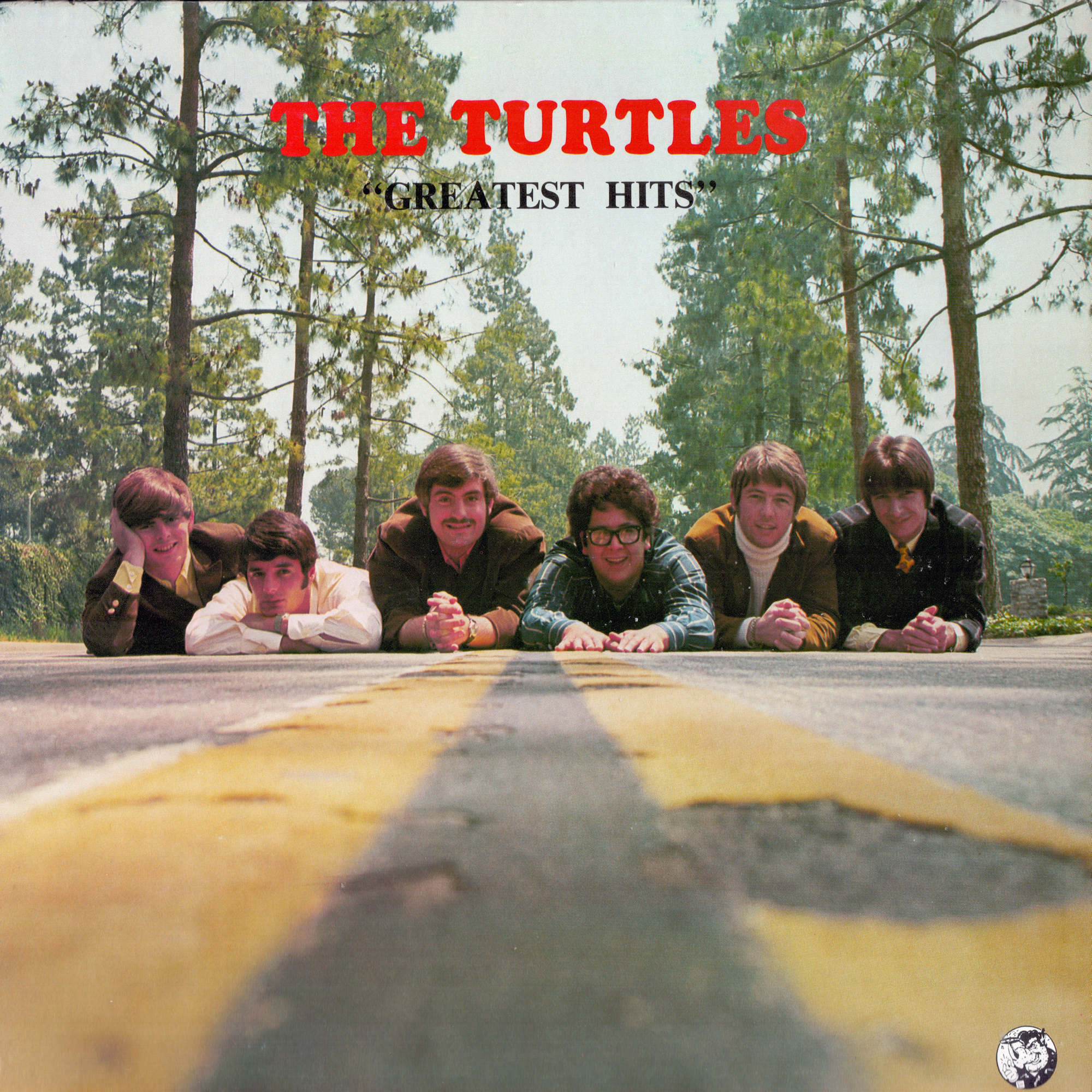
tracks on LP: It Ain’t Me Babe | Let Me Be | You Baby | She’s My Girl | Can I Get To Know You Better | Love In The City | Elenore | Happy Together | She’d Rather Be With Me | You Know What I Mean | Sound Asleep | You Don’t Have To Walk In The Rain | You Showed Me | The Story Of Rock & Roll
Record label: Rhino Records RNLP 160
Released: 1982
Purchased: 13/08/83
On the verge of breaking up after more than three years as a top dance band in Los Angeles, the Crossfires changed their name to “The Turtles,” signed a record deal with two guys who didn’t even know what their company was going to be call-ed, and recorded four songs. IT AIN’T ME BABE, an arrangement of a Bob Dylan song, became the first single for White Whale Records, and established the Turtles with a Top Five hit single.
The group was very influenced by the English rock sound, and singer Howard Kaylan cites vocal influences of the Zombies’ Colin Blunstone on this first hit. The rest of the band was composed of Mark Volman, vocals; Al Nichol, lead guitar; Jim Tucker, rhythm guitar; Chuck Portz, bass; and Don Murray, drums. All of a sudden the group had gone from hanging out at bowling alleys ‘where they’d order tea with plenty of milk, fake English accents and try to pass themselves off as Gerry and the Pacemakers, to the legitimate bigtime of hits, nationwide tours, and radical changes in lifestyle.
One look at the cover of their first album, “It Ain’t Me Babe” (which has recently been reissued by Rhino Records), and it was apparent that the Turtles, at least image wise, identified more with the scruffy, scowling Rolling Stones than with the cuter, Beatle-ish bands. “We looked more like the MC5,” Volman recalls.
Their next hit, LET ME BE, was consistent with this image. Songwriter P.F. Sloan approached the Turtles during a rehearsal with a proposed follow-up to their first hit. The group turned down “Eve of Destruction,” and opted for the less radical “Let Me Be.” It was similar to their first single in that it established a modus operandi of drawing the listener in with a soft, sensitive beginning only to smash the tranquility with a hard, defiant chorus. A statement of sullen adolescent independence, it summed up where the Turtles were at in 1965.
YOU BABY was next, and, all of a sudden, the band changed pace with a more wholesome approach. After a year of screaming about the impending end of the world, the group felt the need to break out of that cast of doom and opted for a Lovin’ Spoonful-inspired, Good Time feel. It’s also special as it was one of the few pop records to feature a drum pattern as the prime hook.
The Turtles | Greatest Hits | Rhino 1982

The group’s next single, the moody, psychedelic “Grim Reaper of Love,” was too weird and only managed to chart in the 80’s. So the boys came roaring back with another pop tune, CAN I GET TO KNOW YOU BETTER. They lost their drummer, Don Murray, who just walked away in the middle of recording the song. At the time there was speculation that Don buckled under the emotional pressure, which wasn’t made any easier due to his resemblance to Paul McCartney. (Don now drums with the reformed Surfaris.)
The next day John Barbata appeared. He had been recommended by Gene Clark (formerly of the Byrds), and before that in the Sentinels surf band. Shortly thereafter, Chuck Portz became discontent with the rock lifestyle, and he departed. Chip Douglas, another recommendation of Gene Clark’s, filled the slot.
It had been a long time since the Turtles last big hit, and they needed one badly. From a stack of publishing demos came a scratchy recording of a song, HAPPY TOGETHER. The Turtles knew it was a hit song, even though it had been passed on by everybody else who’d heard it. “It was just a simple demo,” recalls Kaylan, “just a guitar, voice and somebody keeping time by slapping their thighs. The publishing company flew the writers—Gary Bonner and Alan Gordon—out to Los Angeles to play the song for us, and it sounded exactly the same as the demo, except for the scratches.”
In any event, the group sat on the demo for eight months before recording it. Chip Douglas arranged the horns. At the end of the next tour, just as the record started to climb the charts, Douglas left the band to produce the Monkees. Jim Pons, bassist of the Leaves (most remembered for “Hey Joe”), left to join the Turtles. “Happy Together” hit Number One, and became the song that the group is most identified with.
SHE’D RATHER BE WITH ME, another Bonner and Gordon song in the same jovial mold, climbed to number three, and was the group’s biggest International hit. The Turtles played England for the first time, which provided an unusual experience. The band was heavily influenced by the Sgt. Pepper, psychedelic period. Kaylan and Volman, along with Nichol, presented an impressive vocal sound, while Barbata’s varied, dynamic drumming invigorated the group.
They duplicated their recordings live, and were getting more into theatrics. Britain’s rock elite came to see them—the Beatles, Jimi Hendrix, Brian Jones (every night). But there was one casualty—Jim Tucker left the band. It was disorienting for the Turtles, currently with two big hits in the States, to come to England and play dingy little clubs like the Speakeasy and Blazes, where they played standing on tables. Quite frankly, it felt like starting over, and this got to Tucker. In addition, the Beatles were gods to Tucker, and when he saw Lennon and McCartney acided-out, crawling around under tables, taking pictures of candles, it apparently became too much, and he was gone. The Turtles were now a five-man band.
YOU KNOW WHAT I MEAN was next, and despite being an unusual jazz-waltz, it still made it to number 12. The acid influences strengthened, and Kaylan and Volman refer to it as the weirdest of all their hits. For the end tag they had the original background vocals piped into the echo chamber, where they proceeded to sing along with themselves for the final mix. Jack Nitzche arranged the strings.
The Turtles | Greatest Hits | Rhino 1982

But even stranger—within the context of these pop hits, mind you—was SHE’S MY GIRL. Volman and Kaylan recall: “It was getting real mental, like with Jim Pons freaking out and thinking he was John Lennon as the Walrus.” To top if off, Joe Wissert, their producer, seemed even stranger to them. He would eat gingerbread bats while reciting poetry. Bob Jenkins was called in to play congas. Kaylan and Volman swear that, on the background vocals, they are singing “morning glory” followed by “yogananda . .” It’s among the favorite songs they ever recorded.
After that experience, the Turtles, using all the clout they could muster as a hot act, convinced White Whale that they should produce themselves. Four rough songs were recorded, with SOUND ASLEEP being the only one that White Whale thought was good enough to finish. (The other three can be heard on “The Turtles-1968,” Rhino RNPD 901). This one answered the question, “how high can you get and still have a top 40 hit?” With a tree falling from side to side in the stereo version, and with “Waiting for the Robert E. Lee” sung over the end, the Turtles, in a sense, became the Beatles. They even established their own production company. The Beatles had Apple, so they formed Blimp.
Despite mixing the song five times, they maintain that the only good mix is the mono one, which is included here. The song, in a German translation—”Dondolo”—by Rex Guildo, became a big hit in Germany. After this Indulgence, and the disappointing sales, White Whale insisted that the Turtles have a producer. They chose Chip Douglas because they knew they could “push him around.” Not only would he work for the record company, but he would represent the group’s best interests.
It was a post-acid respite of getting back to the rock ‘n’ roll roots. The Stones had “Jumpin’ Jack Flash,” the Beatles “Lady Madonna,” and so the Turtles recorded THE STORY OF ROCK AND ROLL. Harry Nilsson wrote and played piano, Plas Johnson played the sax, and Howard and Mark debuted “The Incredivoices” —the high-girl-singer-sound—that they would later add to T. Rex’s hits and others. It still didn’t turn the trick, and the record company moaned even more for “another ‘Happy Together.’”
The Turtles | Greatest Hits | Rhino 1982
Howard decided he would give it to them. When ELENORE was completed, it was a satire of the type of “Happy Together” song, and the group parodied themselves as the super-clean pop band. While some lyrics, like “fab and gear, etc.” were dropped for others, “pride and joy, etc.,” the attempt at humor was glossed over, arid record buyers took the single as a serious love song, all the way up to number six. It was, probably, the first pop record to have an early use of the Moog synthesizer, in the second verse, as played by Paul Beaver. An Italian version by Gianni Morandi topped the charts in Italy for 16 straight weeks.
YOU SHOWED ME was an early Byrds composition, but a brisk, Beatle-ish rocker. When Chip wanted to show the Turtles what the song sounded like, his only musical device was a pump organ with a broken bellows, so it could only play in a slow tempo. Chip was upset, but the Turtles responded with a “that’s it,” and it was too, as the enchanter matched “Elenore” in sales. It was also a way the Turtles could pay back Gene Clark, as he wrote the song with Jim—now Roger—McGuinn.
In was another period of transition for the Turtles. Barbata left to join the then-forming Crosby, Stills and Nash. John Seiler, drummer with Spanky and Our Gang became the replacement. White Whale wanted Mark and Howard to fly to Memphis to put their voices to already existing backing tracks and call it “The Turtles,” They rebelled and went further in the other direction by insisting the Turtles become a real “group” again, with more participation—songwriting, lead vocals—from the other members.
The Kinks “Village Green” LP had just come out and blown the group away, so they decided to ask Ray Davies to produce their next album, “Turtle Soup.” YOU DON’T HAVE TO WALK IN THE RAIN, a continuation of the tongue-in-cheek pop style, was another competent effort with the soft-into-hard approach. It topped out in the fifties, but LOVE IN THE CITY, a more interesting record, was even more overlooked and fared worse. It was the Turtles version of a “Summer In The City,” an atmospheric record whose impact was diminished when Ray Pohlman’s massive, neophonic strings were buried by the group in an effort to maintain more of the Turtles (i.e. band) identity. Mark played the congas.
Amidst a dearth of hits, a legal battle against their record company, and other problems that squeezed the fun out of what they were doing, the Turtles dissolved. The Turtles output represents a microcosm of the 1960’s post-Beatles rock experience—from folk-rock to pop-rock, with acid-rock thrown in. In an effort to preserve the Turtles archives with a great degree of care, Rhino will, from time to time, be reissuing various records, all mastered from the original tapes. While the Turtles were most well known for their hits, their cleverness and adventurousness was largely overlooked. In any event, it’s doubtful that the qualtity of the hits contained in this LP could be matched by any American rock band of the 1960’s They were that good.

Leave a Reply